- represents the chance that the image b represents the true map before any data is taken into account.
- This ``prior probability'' is a measure of how simple an image is
- Simple images are more probable (a priori) than complex images

? 
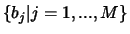
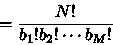
|
(1) |
|
(1) |
The a priori probability of getting a given image b is therefore
this number divided by the number of all possible maps:
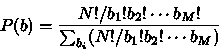 |
(2) |
If there are many photons in each pixel ( ) we can use
Stirling's approximation for the factorial,
) we can use
Stirling's approximation for the factorial,
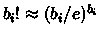 .
Using this,
.
Using this,
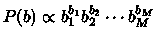 .
.
It is much more convenient to normalize all the pixel intensities  to the so-called ``grey map'', where all the intensities equal the
mean value
to the so-called ``grey map'', where all the intensities equal the
mean value  .
.
 |
(3) |
where  is a normalizing constant that guarantees that sums to 1
over all possible maps
is a normalizing constant that guarantees that sums to 1
over all possible maps  . is the probability of the ``grey'' map,
since all the factors
. is the probability of the ``grey'' map,
since all the factors  in equation (3) are 1 in that case. It can be shown that
is the maximum value of .
in equation (3) are 1 in that case. It can be shown that
is the maximum value of .
None of this looks at all like the ``entropy'' term we all know and love in
MEM, but equation (3) can be re-written in an exponential form which gives us the
so-called ``entropy'' term
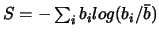 .
.
 |
(4) |
In our derivation,  , but Skilling and Gull (1989) and Skilling (1989) argued that
it is an indeterminate free parameter of the probability distribution, and this free parameter
is used in virtually all MEM programs.
, but Skilling and Gull (1989) and Skilling (1989) argued that
it is an indeterminate free parameter of the probability distribution, and this free parameter
is used in virtually all MEM programs.
Now that we have the ``prior'' probability, we need to find the "likelihood".
The "likelihood"  (``P of D given b'') is the probability that the
observed data D could have been generated from a given image b. )
(``P of D given b'') is the probability that the
observed data D could have been generated from a given image b. )
This probability is computed using the difference of the simulated data
 computed from some guess for the image b and the real data D. For
Gaussian statistics,
computed from some guess for the image b and the real data D. For
Gaussian statistics,
 |
(5) |
In somewhat more generality,
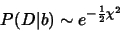 |
(6) |
 is a valid measure of departures from data. If the number of photons
is small, one must use something like the C-statistic (Cash, 1978).
is a valid measure of departures from data. If the number of photons
is small, one must use something like the C-statistic (Cash, 1978).
But what we want for the deconvolution is not but  ,
that is, the probability of the image b given the data D. This is given
by Bayse's theorem:
,
that is, the probability of the image b given the data D. This is given
by Bayse's theorem:
 |
(7) |
is the likelihood
of the data given b, and P(D) is a constant which normalizes
to a sum of unity, and gives the probability of the data.
At last we can write down the quantity to be maximized. Inserting the
expressions (2) and (4) for and
into equation (5), we get:
 |
(8) |
 ),
which is the same as maximizing
),
which is the same as maximizing  :
:
 |
(9) |
The first term is the constraint of the data; it is 0 when the image matches the
data perfectly, but in realistic cases is  when
the data are fitted but not ``over fitted''. The second term
is commonly called the "entropy" term, which guarantees the "simplicity"
of the image. (It is not really the entropy in the sense used by Shannon (1948),
but the weight of common use forces us to call it that.) The ``entropy''
term is maximum (0) when
when
the data are fitted but not ``over fitted''. The second term
is commonly called the "entropy" term, which guarantees the "simplicity"
of the image. (It is not really the entropy in the sense used by Shannon (1948),
but the weight of common use forces us to call it that.) The ``entropy''
term is maximum (0) when  . That is, the ``grey'' map is a priori
most probable.
. That is, the ``grey'' map is a priori
most probable.
Note the arbitrary coefficient  giving relative weight to the
``entropy'' term. If , Bayesian logic would give equal weight to
each term, but MEM algorithms usually weight them differently to provide simpler maps (
giving relative weight to the
``entropy'' term. If , Bayesian logic would give equal weight to
each term, but MEM algorithms usually weight them differently to provide simpler maps ( )
or maps more faithful to the data (
)
or maps more faithful to the data ( ). It is possible, using
Bayseian arguments, to estimate the most probable (Skilling 1989)
). It is possible, using
Bayseian arguments, to estimate the most probable (Skilling 1989)
Since the dimensionality of the parameter space for MEM is the number of map
pixels, we cannot show contours of the function  ) in a realistic
case. Instead we show a case for 3 pixels, {
) in a realistic
case. Instead we show a case for 3 pixels, { }, where the sum
of the pixel brightnesses equals 100. This reduces it to a 2-dimensional
problem. In the figure below, the dashed contours represent the entropy
function
}, where the sum
of the pixel brightnesses equals 100. This reduces it to a 2-dimensional
problem. In the figure below, the dashed contours represent the entropy
function  , and the solid contours show the function. The
squares are located at the maximum of
, and the solid contours show the function. The
squares are located at the maximum of  for different values of
". When
for different values of
". When  , the maximum is located at the entropy peak,
and when
, the maximum is located at the entropy peak,
and when  , it is located at the minimum of .
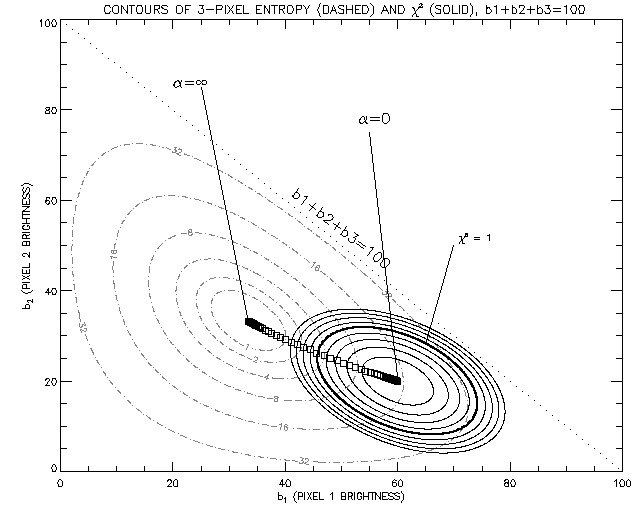
function will always be
ellipses with, of course, different centroids and axial ratios.
The goal of MEM is to find the optimum
value along this curve, somewhere in parameter space between the "prior" grey
map and the map which fits the data exactly. Skilling has argued that the
``most probable'' is the one that makes the number of ``good'' measurements
equal to - , which is the (dimensionless) amount of structure in
the map . The number of ``good'' measurements is defined by a sum over curvature
terms in the likelihood matrix (Skilling 1989).
, which is the (dimensionless) amount of structure in
the map . The number of ``good'' measurements is defined by a sum over curvature
terms in the likelihood matrix (Skilling 1989).


