


In the absence of noise, the HESSI modulation profiles are sums of sinuoidal transforms like:

where the wave vector components uj and vj are functions of the orientation
angle  and the pitch p:

and  is the instantaneous collimator phase, to be obtained from
the aspect system.
is the instantaneous collimator phase, to be obtained from
the aspect system.
Our objective is to determine the visibilities, which are Fourier transforms very similar in form to (1), except having the sine and cosine terms in the real and imaginary parts:

The way to obtain the quantities (2) from the measured values (1) is,
as shown below, to take a certain linear combination of successive
values 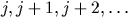 and separate out the cosine and sine
transforms. There is one complication, however, and that is that the
wave vector (uj,vj) changes direction as j and change.
To mitigate this effect, we shift the transforms to the ``phase
center'' (x0,y0), which is the center of the map to be made later.
Equation (1) then becomes:
and separate out the cosine and sine
transforms. There is one complication, however, and that is that the
wave vector (uj,vj) changes direction as j and change.
To mitigate this effect, we shift the transforms to the ``phase
center'' (x0,y0), which is the center of the map to be made later.
Equation (1) then becomes:

which looks very similar, except for the new phase shift  .
.

From now on, we treat x-x0 and y-y0 as first-order quantities,
and x0 and y0 as zero-order quantities in a series expansion.
We do the same thing with the angle:
 , where
 is zero-order and
 is first-order.
So


Then


Inspection of equation(3) shows that the first place where uj and
vj appear has the first-order factors x-x0 and y-y0, so
we can neglect the second-order products  and
and
 in that part of the equation. Our translation to
the new phase center has caused the first-order effects of rotation
to appear only in the phase angle :
in that part of the equation. Our translation to
the new phase center has caused the first-order effects of rotation
to appear only in the phase angle :

We clean up the mess by writing  ,where
  is the zero-order quantity
 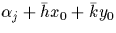 , while
  , being proportional to
, is first-order. Then the modulation harmonic term
simplifies to:
, being proportional to
, is first-order. Then the modulation harmonic term
simplifies to:

This is very similar to (1) except that the new phase angle is
a strong function of the rotation, and assuming changes slowly
during a modulation cycle,  will change by about
  .We can therefore pick two or more time-angle bins within a cycle, and
have two or more independent sinusoid transforms
.We can therefore pick two or more time-angle bins within a cycle, and
have two or more independent sinusoid transforms  . Using
the cosine sum formula, we can then
extract the cosine and sine transforms
. Using
the cosine sum formula, we can then
extract the cosine and sine transforms  and
and  :
:

where the cosine transform is:
![\begin{displaymath}
\Phi_c = \int\int cos(2\pi[\bar{u}(x-x_0) + \bar{v}(y-y_0)])\
f(x,y)\ dx dy, \end{displaymath}](img31.gif)
and the sine transform is:
![\begin{displaymath}
\Phi_s = \int\int sin(2\pi[\bar{u}(x-x_0) + \bar{v}(y-y_0)])\
f(x,y)\ dx dy. \end{displaymath}](img32.gif)
The solution to the HESSI visibility-extraction problem, then, is to do a regression model of the form (5) to the modulation profile values during a single cycle of modulation, and obtain the visibility as:

A bare-bones IDL program to do this (modprof2visibility.pro), which determines the fit to (5) by a least-squares method, will soon be placed in the HESSI SSW tree.