If our goal is to use a uniform grid as support for the visibilities
(that is, each time bin corresponds to a pixel of the gridded UV
plane), we have to choose a fine enough grid that all points are
independent. The innermost UV circle must therefore be large enough
that no bins overlap, for if they do, there is no one-to-one
correspondence between the UV map and the time bins, and there is a
poor representation of the UV circle. (This is the greatest weakness
of the rectangular representation.) It is easy to calculate that for
25 time bins (column 3 in Table 1), the finest grid that has no
overlapping UV points has a radius of 9 pixels for the innermost UV
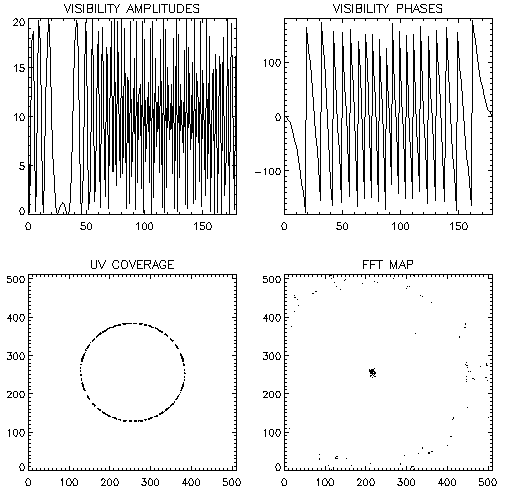
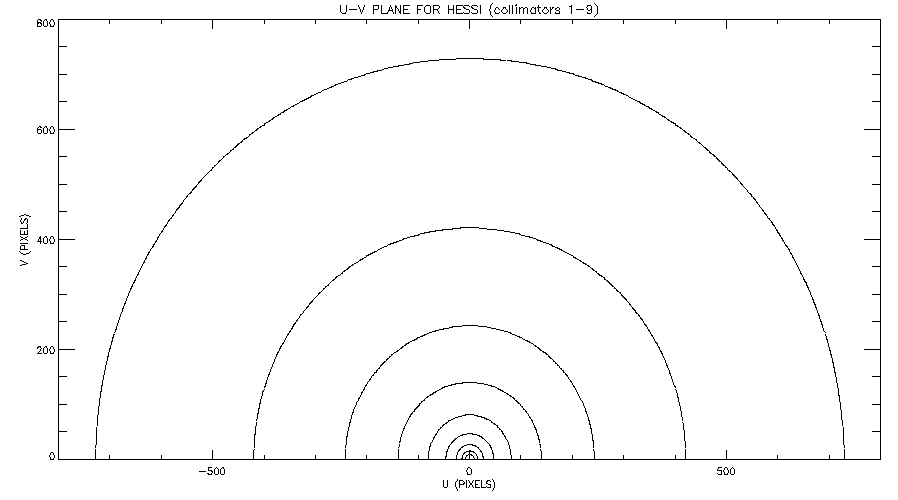
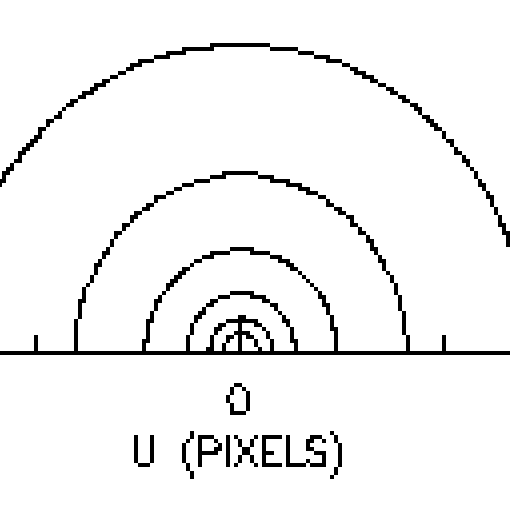
circle. The UV coverage is shown in Figure
1, and a zoomed version shows
the innermost circles. The radius of the largest UV circle is 81
times the radius of the smallest circle, So for the binnings of column
3, the radius of the largest UV circles would have to be 729 pixels,
respectively. If the visibilities are to be put into square arrays
suitable for IDL's FFT, the arrays would have to be big enough to
contain the largest UV circle. Using the next power of 2 exceeding
 , the arrays would be
  .
.
Clearly, these arrays would be very sparse, and careful management of
memory would be important if we used this representation. It is
probably not efficient to use the standard 2D FFT for such arrays.
(In IDL, the FFT of a complex array is
computationally equivalent to about  floating point
multiplications.) Another problem with this representation is that the
inner circles are not rendered very faithfully by nearest-neighbor
sampling of circles, and some kind of interpolation might be
necessary.
floating point
multiplications.) Another problem with this representation is that the
inner circles are not rendered very faithfully by nearest-neighbor
sampling of circles, and some kind of interpolation might be
necessary.